#1
So this week, we got some interesting activities to do, including some fun puzzles and riddles. I am a sucker for brain training, so these simple but interesting riddles was fun to think about. Here are my answers for them:
- A man is replacing a wheel on his car, when he accidentally drops the four nuts used to hold the wheel on the car. They fall into a deep drain, irretrievably lost. A passing girl offers him a solution that enables him to drive home. What is it?
So this is not actually a riddle, more of a concept to inspire creative thinking. My first idea was that the girl just drives the guy to the nearest car-shop to get some new nuts. Another idea I had was that she told him he could take one nut from all the other tires; thus having three nuts holding the wheel in place on all the four tires. Another thought I had was that the girl had a piece of string and a magnet, which she tied together and sort of fished the nuts up from the drain, McGyver-style.
- Two Russians walk down a street in Moscow. One Russian is the father of the other Russian’s son. How are they related?
Don’t know why they have to be russian, but what the hell. So one of them is the father of the other russians son. This can have different solutions, such as both of them being a gay couple, and they are both parents of the same adopted son. Another solution is that they are just man and wife, with a son. - What occurs once in June, once in July and twice in August?
The answer is so simple it is actually infuriatingly difficult to figure out. June and July only have one U, whereas August has two. - Six drinking glasses stand in a row, with the first three full of water and the next three empty. By handling and moving only one glass at a time, how can you arrange the six glasses so that no full glass stands next to another full glass, and no empty glass stands next to another empty glass? What is the minimum number of moves to solve this puzzle?
Just pour the contents of the second glass into the fifth glass. This way no empty glass stands next to another, and no full glass stands next to another full glass. So the answer is one move.
#2
In this activity, we were assigned to research the SCAMPER model. The S.C.A.M.P.E.R model is
Assignment:
Use the Internet to research the history of the fast food chain McDonalds and explain which parts of the SCAMPER model are evident in its development onto its current success.
This assignment was a lot of fun to do, because I remembered the movie «The Founder» from 2016 with Michael Keaton playing Ray Kroc, the mind behind the McDonalds we know and love/loathe today. In the movie Kroc is portrayed as a smart but somewhat cynical guy who sells vacuum cleaners until he eats at one of the early McDonalds restaurants and sees the potential of their business.
So what exactly is the S.C.A.M.P.E.R model?
S – Subtitute (Replace a part of your product, service or process with another).
C – Combine (Combine ideas, processes or products into one more efficient output).
A – Adapt (Adapt an existing idea that might not have worked before to solve a problem).
M – Modify or Magnify (Modify an aspect of your situation or problem, for example by magnifying or minifying them).
P – Put to other use (Put current processes or products that were intended for a specific purpose to other use).
E – Eliminate (Eliminate or simplify a process or idea to get to improve it, but also to identify its most important aspect).
R – Reverse or Rearrange (Reverse the orientation or direction of a process or product, do thing the other way around).
S for «SUBSTITUTE»- They started to serve French fries in 1949, instead of chips.
- They changed the the original “McDonald’s Bar-B-Q” to “McDonald’s” in 1948. In the movie, Kroc says at the end that the McDonalds name was what he really wanted to own. «Nobody would eat at a restaurant kalled Kroc’s».
- They switched from real milkshake made with dairy to a powder-based milkshake
- They replaced their logo “Speedee” in 1962 with the world famous Golden Arches logo that we all know.
- They introduced a new mascot on 1963, a clown called Ronald McDonald. Previously, they had used a mascot called Speedee.
C for «COMBINE« - McDonalds became known for their efficient and streamlined process when they were making food. The Speedee Service System they introduced in 1948 was improved further by Kroc later.
- They started franchising the McDonalds restaurants in 1954. Ray Kroc bought a franchise and started doing business with the McDonalds brothers until he ultimately stole it from them. Kroc expanded McDonald’s to become the most franchised restaurant in the world.
- In 1979 Mcdonald’s started to include toys with the food, by offering a selection of toys as a “bonus”. The Happy Meal was born and the company increased revenue by making their restaurants more family-oriented.
A for «ADAPT» - When they reopened in 1948 they had a self-service drive-in restaurant.
- Over the years, they have added many different items to their menus. They even serve salads nowadays.
M for «MODIFY/MAGNIFY» - McDonald’s managed to increase their sales by introducing popular toys with meals. Often with special promotions connected with a moviestudio like Disney.
P for «PUT TO OTHER USE» - The first Ronald McDonald House opened in Philadelphia, Pennsylvania in 1974.
- The world’s first McCafe opened in Melbourne, Victoria Australia in 1993.
- McDonalds franchised not only their brand, but also the real estate of their restaurants.
E for «ELIMINATE» - The McDonalds brothers reduced their menu in 1948. Their new menu had only nine items. The menus looked like this: Hamburger, cheeseburger, soft drinks, milk, coffee, potato chips and a slice of pie.
- McDonald’s use different menus in different countries, in this way they cater to specific countries taste and way of living.
- In 1969 the old Mcdonald’s restaurants were demolished to introduce a new design, with indoor seating. This became the new standard for every Mcdonald’s subsequent building.
- The restaurants eliminated having to pay waiters, by making people get the food themselves.
R for «REVERSE/REARRANGE» - The McDonald brothers shut down their restaurant for three months in 1948. They decided to try something different and reduced their menu.
- During the «burger wars» in the 80s, Mcdonalds started selling “McChicken”, which was a disaster. They decided to replace it with the “Chicken McNuggets” which became a popular item on the menu.
#3
Assignment:
- You are given a teaspoon as an object. Now apply each one of the SCAMPER techniques to it and give a brief explanation of what new product comes of this and how it can be marketed.
So how can you market a teaspoon in a new and exciting way? This seems almost impossible due to the fact that we humans have . You just cannot beat the simplest . So my idea for this new product is to go simple and classic with a few minor tweaks. That is pretty much all us humans want isn’t it? The same but different.
Substitute
So how can you substitute something in the design of a spoon? You cannot mess with the overall design, because the spoon has to perform it’s main function. You could substitute the shape a little, making the spoons «head» a little larger. Also you could make the handle a little more comfortable. The most obvious thing you could substitute is the material the spoon is made from. My idea is to use a bio-degradable material, like biodegradable acetate. This material is sturdy like other plastics, but . Another idea would be to make the spoons out of recycled material. This way you could market the spoon to the growing number of enviromentally-minded people all over the world. If you flatten the end of the spoon, it would be easier to scoop the final remains of e.g. yoghurt.
Combine
You could combine a lot of other household objects with the spoon. The problem would be that the design would most likely be clunky and unwieldy. I would really like to add is some sort of measuring . Another idea I had was to combine a thermometer with the spoon, thus knowing how hot your food was. This could be problematic though, with having to have a display to read the temperature on a small spoon.
Adapt
You could adapt the design or materials that other successfull companies have used. Someone probably have made different spoons with different ideas similar to the ones I have listed here. You could learn from their products, and improve their original design.
Modify/magnify
So what could you modify. My idea is to go really crazy with the packaging. Maybe a huge box that looks like a spoon, made from bamboo or other sleek wooden materials.
Put to other use
The spoon could be used to measure smaller doses, like 1 oz. It could also be used as a simple thermometer.
Eliminate
You could eliminate traditional marketing and only sell it online. By selling the spoon in limited quantities, you could create buzz for new shipments.
Rearrange
Organize all marketing of the product on social media. Make it cool to have the product, the marketing should focus around the enviromental aspects.
Assignment:
- You have to design packaging for rice. The packaging has to be different from what is out there in the market. Apply each one of the SCAMPER techniques and do a write‑up on your findings. Then choose the option that you think would work best and do a sketch of what the packaging would look like.
Rice. Rice never changes. So this is the dilemma with creating a new packaging for rice. It’s pointless and redundant. The packaging for rice needs two things: Simplicity and cost-efficiency. That is why almost all the rice packaging you see in the store looks identical. It is either in a huge bag, for convenience and value for money; or it is in a traditional rectangular box most often made out of cardboard. To make anyone want to buy a type of rice solely on the packaging is tough. Here is my attempt.
Substitute
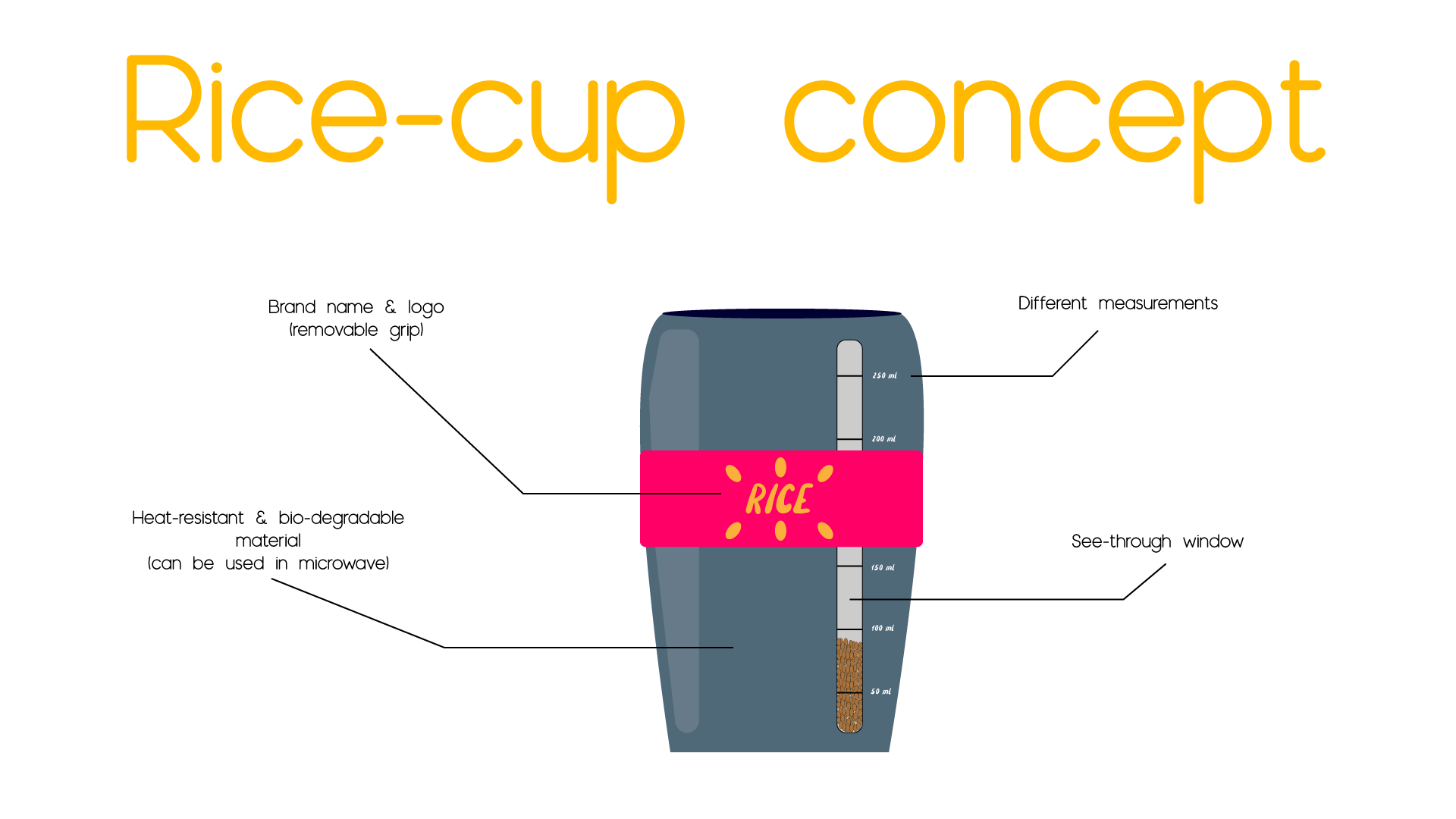
I would substitute the traditional packaging with medium sized cups containing rice. The cups would be sold in batches, and the point would be that the cups contain exactly the needed amount of rice of one adult person. The material would be made out of heat-resistant plastic, most preferrably bio-degradable.
Adapt
You could partner with a large company. This way you could have the company logo on the cups. You could also encourage recycling of the product, thus creating new cups, saving cost and the enviroment.
Combine
Each of the cups would have a see-through window along the height. In this window, you could see different measurements like a traditional measuring jug. You could use different measurements in different countries. I’m looking at you U.S & U.K.
Modify/magnify
It could come in different colors. This way you could create demand for the more rare colors, and encourage collecting all the cups, thus increasing sales.
Put to other use
You could use the cup as a drinking glass, a container for your stuff or a coffe cup. You could also use the cups to measure other cooking-related things like salt or milk.
Eliminate
By eliminating a store, you can maximize profit with sales over the internet. With the collecting aspect, you will be eliminating garbage.
Rearrange
Sell it online with a tie-in with a company. You could also rearrange any design element easily, as the cost would not be too great.
I made a sketch in illustrator to visualize some of my ideas. I am actually quite happy with the result. I would love any feedback.
 My Reflective Journal
Legg igjen en kommentar